‘The Wide Wide Sea’: Captain Cook expands England’s knowledge of the Pacific Islands and the Arctic Circle
by Don Porter
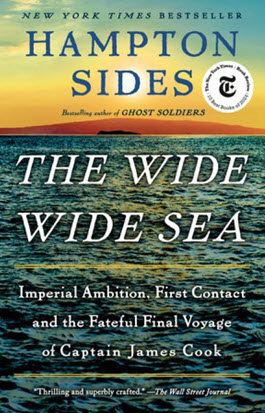
In his book “The Wide Wide Sea: Imperial Ambition, First Contact, and the Fateful Final Voyage of Captain James Cook,” author Hampton Sides paints an interesting picture of Cook, who was renowned for his seamanship, and as a scientist and excellent cartographer (aka: map maker).
Highly respected in England, by the Royal Navy and the Crown, on July 12, 1776, Cook set off on his third and final voyage on his ship, the HMS Resolution. Captain and ship were accompanied by the HMS Discovery under Captain Charles Clerke (pronounced “Clark”), Cook’s second in command, who was 16 years younger than Cook. The full journey lasted almost four years and neither Cook nor Clerke would return to England alive.
Although Cook was very interested in learning about the indigenous people he encountered on the expedition, it would be a clash of cultures that would be his undoing in the Hawaiian Islands. It was reported that during this third trip Cook had changed. He seemed tired and often in discomfort. He had always demanded cleanliness and the consumption of fresh fruits and vegetable to help curb disease, but on this voyage he was much tougher with punishments doled out among his crew.
In “The Wide Wide Sea” it’s apparent to the reader that author Sides did extensive research on Cook and the preparations he undertook for such a difficult trip. The complexity of providing for his crew and planning the navigation, including to some parts that were yet unknown, were Cook’s responsibility.
His charge by the British Admiralty was to discover a Northwest Passage between the Atlantic Ocean and the Pacific Coast of North America. Dedicated to that end, Cook attempted to find something that we now know did not exist. But in doing so, he discovered the Hawaiian Islands that other explorers had missed. He named them the “Sandwich Islands” in honor of a one of his supporters in England—Lord Sandwich.
It was Cook’s return to the Big Island of Hawaii on his way back to England that led to the violent end of his life in 1779. A monument in Kealakekua commemorates the location of his death. Captain Clerke took command of the expedition upon Cook’s death, but died from tuberculosis later that year. (He had contracted TB in a debtors’ prison in England prior to this journey.)
The book “Wide Wide Sea,” published in 2024, was chosen as a Best Book of the Year by the New York Times, Time Magazine, NPR and The Smithsonian Institution.
Don Porter is a former Stockbridge Schools deputy superintendent. He also served as assistant principal at the Jr./Sr. High School, and then principal at Smith Elementary, Katz Elementary, and Heritage School. He and his wife, Tammy, live in Stockbridge and enjoy fly fishing, golf, traveling, and working in the yard.

Related Posts

Paid Political Advertisement

Munith Halloween Parade & Costume Contest: Sat., Oct. 24