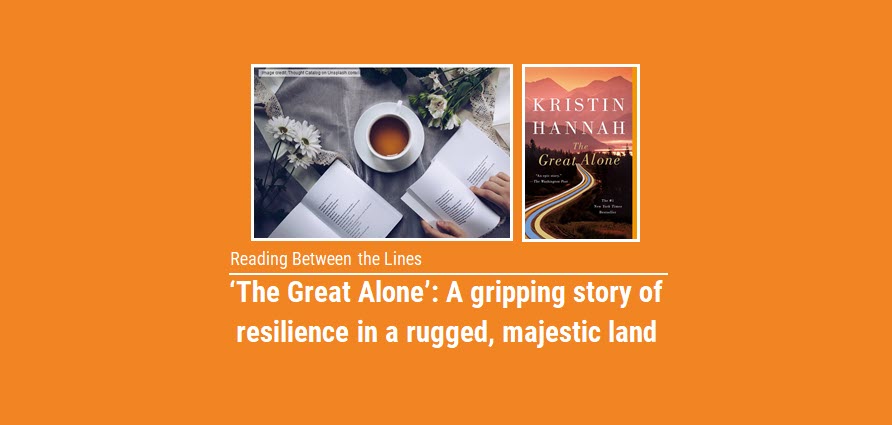
Reading Between the Lines: The Great Alone’ is a gripping story of resilience in a rugged, majestic land
by Mary Jo David
Many who are familiar with popular fiction have heard of Kristin Hannah. “Firefly Lane” (2008) and later “The Nightingale” (2015) both skyrocketed in popularity and have maintained their hold as commercial successes over many years. “Firefly” became a popular Netflix series in 2021 and “Nightingale” is probably the novel for which Hannah is most well known, followed closely by “The Women” (2024).
As an avid reader, I recommend other book lovers try to insulate themselves from ubiquitous, fawning reviews of popular titles that jump to the top of bestseller lists and immediately become go-to books for book clubs everywhere. It’s rare for a novel to live up to that kind of hype, which was the problem I had when I read Hannah’s “The Women” (reviewed in this column in September 2024). I admit it is happening again with Allen Levi’s “Theo of Golden,” a good book, but not one I’d classify as “the best ever,” as so many readers had, by the time I read it. But I digress.
It just so happens, I am a Kristin Hannah fan. I enjoyed all three of her books mentioned above, and I endeavor to make my way through many more of her titles. This spring, I picked up “The Great Alone,” a Hannah book I hadn’t heard much about. Most of the book is set in the mid-1970s, near Homer, Alaska, in a fictitious village called Kaneq along the rugged Kachemak Bay.
The Allbright family moves to Kaneq after burning all their bridges in the Seattle area. The main character, Leni, is 13 when she moves to Alaska with her dad, Ernt, and her mom, Cora. Ernt—a Vietnam POW—returned after the war with extreme PTSD, although that diagnosis didn’t exist at the time. Due to her dad’s inability to adjust to societal norms, Leni has moved from school to school and has never been able to form strong friendships. When her dad gets word that he’s inherited land and a cabin in Alaska from an old army buddy, Leni and her mom do what they always do—they jump on the bandwagon and support Ernt’s latest adventure, moving to the Last Frontier.
As they set out on their journey in an old VW van, the Allbrights have only each other. Cora has been estranged from her parents since she left as a pregnant teen to marry Ernt, leaving Leni with no memories of paternal relatives and very few of her maternal grandparents in Seattle. Initially when they arrive in Kaneq, Leni and Cora are astounded by the lack of services and how hard the families in Kaneq work to stay alive. Ernt, for his part, sees only possibilities. Folks who live in Kaneq are basically homesteaders who have moved to Alaska to be off the grid, a concept that greatly appeals to Ernt.
Those in the village and outlying areas are skeptical when the Allbrights first arrive, but they are quick to reach out and help the new neighbors get situated in their cabin and on their land—always with an eye to the looming winter. To their credit, the new homesteaders do their best to adjust. Ernt seems to turn a corner; the long summer days and the hard physical labor have him thinking less about his next drink and more about readying the homestead for winter. Cora, who throughout the book is depicted as a petite beauty who responds to her husband’s every need, manages to step up and learn to garden and cook with whatever they can grow, hunt, or catch. And, for the first time in her life, in the midst of chores and schoolwork, Leni makes a best friend.
As winter approaches, the story becomes heavier. Ernt, who already suffers from paranoia, has befriended Earl, the father of his war buddy, and he is becoming deeply entrenched in the conspiracy theories Earl is peddling. Cora, who bears the brunt of Ernt’s anger, has to do more tip-toeing around her husband. As the days get shorter and the nights get longer, it’s Leni who becomes the adult in the family.
And so it goes from year to year as the Allbrights survive four years in The Great Alone.
Until the day that everything falls apart. And the story doesn’t end there.
Hannah does a phenomenal job describing life in a land of extremes, including the beauty of summer and the harshness of winter. Readers can almost feel the sensory impact of the high and low temperatures and sunlight that extends for 16-18 hours in summer and barely squeaks out for six hours in the winter.
Emotional extremes are also prevalent in “The Great Alone.” Friendships are that much stronger when neighbors depend on each other for survival. And the anger—that’s extreme as well. Through Ernt and Cora, Hannah conveys what it must be like to live with a domestic abuser and why, so often, people stay in these situations.
Yes, readers will find themselves anxious and on the edge of their seats as the toxic Allbright family dynamics come to a head. But to her credit, Hannah manages to weave a gripping story of resilience about a rugged but majestic land so many of us have not experienced firsthand (although Hannah has).
I daresay many readers come away from “The Great Alone,” speechless but better off for the experience of having read it. I know I did.