Reading Between the Lines
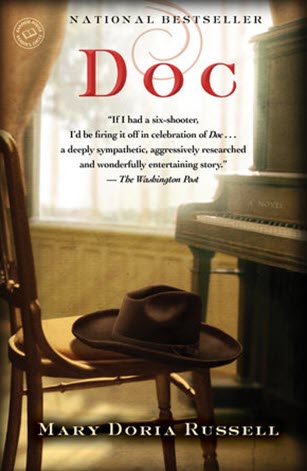
Take a gamble and give ‘Doc,’ by Mary Doria Russell, a try
by Mary Jo David
“Bein’ born is craps … How we live is poker.” (Doc Holliday to Morgan Earp in “Doc.”)
The very reason some people don’t join book clubs is the very reason why maybe they should. By that I mean, I have always shied away from joining a book club because I don’t want to read books I don’t like. Yet, were it not for a book club I joined a year ago, I never would have read the book “Doc” by Mary Doria Russell.
It shouldn’t have surprised me that I enjoyed this book. “The Women of the Copper Country,” also by Russell, is a book I often recommend, especially to people from Michigan, home of the Copper Country. (See Reading Between the Lines, March 2024.) But “Doc” is definitely out of my wheelhouse. The only Westerns I watched were with my dad when I was a kid. Sure, I saw movies like “Tombstone” and “Wyatt Earp,” but only because my husband wanted to see them.
So here was “Doc”—all 400-plus pages—staring me in the face. Do I pretend I read it, or do I skip out of book club all together? Alas, I decided to bite the bullet, per se, and dig in, and I’m so glad I did. Even though it’s fiction, I knew from past experience Russell thoroughly researches her topics, and as a friend of mine put it, “The author has a strong voice and a writing style that is very engaging.”
John Henry “Doc” Holliday, for whom this eponymous work is written is treasured by his mother who dies of tuberculosis when Doc is only 15. Through her influence, he was an excellent student of Latin, French, and even Greek, and was a classically trained pianist. After graduating from dental school at the age of 22, John Henry leaves his father, aunts, uncles, and cousins in Georgia to head west. Leaving his family was tough, but they all hoped sending him West would be better for his “consumption” (likely tuberculosis he contracted from his mother before she passed away).
His command of so many languages, as well as his genteel manners, made him quite the standout in Texas, and later Dodge City, Kansas, but his temper and Southern charm were not always met with openness and appreciation.
Let’s just say that Doc’s “I’ll be damned if I will spend my time listenin’ to ungrammatical, repetitious, imbecilic nonsense without a challenge,” did not always endear him to the roughshod cowboys of Dodge City.
“Doc” is a story about the nucleus of friendships this lonely dentist develops over time. And it’s these characters who grab the reader and pull them in. As my friend also pointed out, when it comes to her characters, Russell has “seemingly unique perspectives across a myriad of historical figures.”
Yes, Wyatt Earp—in fact three of the Earp brothers—figures big into this story. And yes, Doc saves Wyatt’s life, and his smile. But it’s Morgan Earp who Doc develops the closest relationship with, and that friendship would be the envy of anyone then or now.
Big Nose Kate, Doc’s paramour, also happens to be a prostitute and gambler who feeds the baser side of Doc’s personality. But friends like Jau Dong-Sing (aka: China Joe), who runs a laundry, bring out the best in Doc, and he in them. Then there are characters like Bat Masterson—is he a good guy or a bad guy? Read the book and you still may come away wondering. The same is true of Eddie Foy, a talented but selfish entertainer.
While the sheer number of characters mentioned in this review may have your head spinning, Russell strategically weaves their stories in without losing the reader.
In “Doc” you learn so much more about his life than you would in what Russell refers to as the dime novels of the day—the old paperback Westerns. But the book is also a bit of a mystery as Wyatt Earp and Doc, in their own ways, try to figure out what happened to the biracial teen, John Horse Sanders, whom Wyatt had taken under his wing.
Whether you’re interested in the history, the characters, the mystery, or just because it’s on a book club list, I recommend you take a gamble and give “Doc” a try.