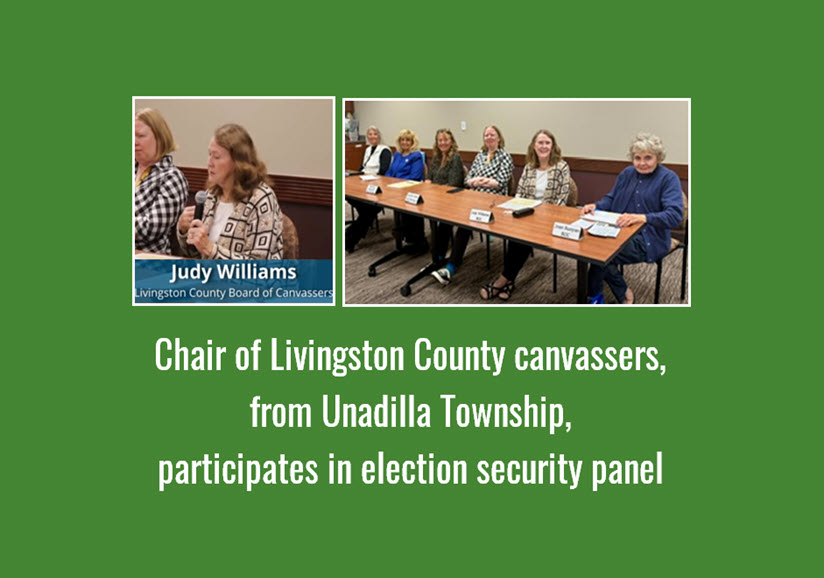
Chair of Livingston County canvassers, from Unadilla Township, participates in election security panel
by Mary Jo David
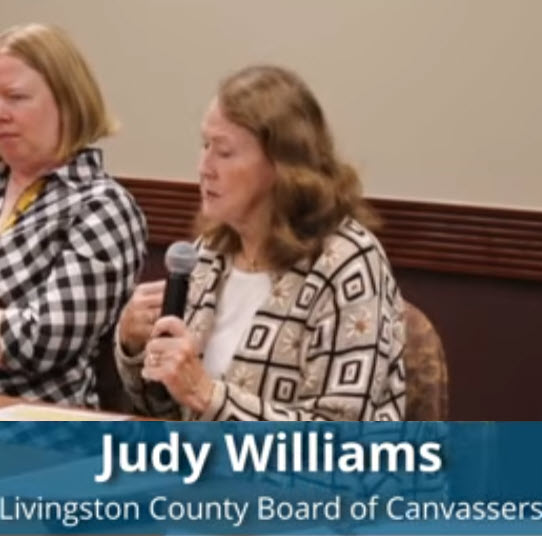
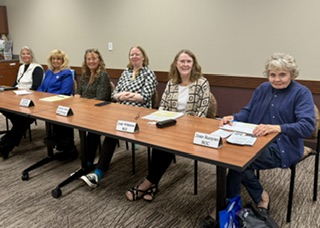
On Oct. 10, Judy Williams of Unadilla Township was one of the representatives from the bipartisan Livingston County Board of Canvassers (LC BoC) to participate in the Election Security in Livingston County Panel Discussion. The panel discussion was hosted by the League of Women Voters of Livingston County at the Hamburg Public Library. Williams, a Democrat representative and chair of the bipartisan LC BoC, was joined by one of her counterparts, Joan Runyan, vice chair, who represents Republicans on the LC BoC.
Others who spoke on the panel included Livingston County Clerk Elizabeth Hundley, Marion Township Clerk/Election Administrator Tammy Beal, and two bipartisan Livingston County election inspectors: Barbara Janowski and Caitlin Geier.
General panel discussion included a brief overview of election security and the checks and balances that keep our elections secure—from decentralized election processes and strict ballot storage rules to bipartisan procedures for resolving disputes. The panel discussion was followed by a Q&A session involving audience members.
For her part, Williams explained the purpose of the Board of Canvassers and the work the board does to certify every election in Livingston County. The LC BoC is independent and composed of two Democrats and two Republicans who are nominated by their county parties and selected by the County Commissioner for a term of four years. Canvassers work closely with the county clerk and the clerk’s election manager. The LC BoC’s role and actions are dictated by law. They operate under the Open Meetings Act, meaning meetings are posted and the public is welcome.
Canvassers physically inspect every ballot container in the county. If precincts receive new containers, the LC BoC has to inspect them. During the week-long process that begins after the Nov. 3 election day, the Board of Canvassers will be reviewing 65 precincts with 88 different ballot styles. The canvassers will review 20 absent vote counting boards (for absent voter ballots) and 15 early voting sites.
Says Williams, “We are going to have 100 poll books to go through. That is one mountain of paper!” The Board of Canvassers goal is to certify the results of the local and county elections and ballot questions. They will also manage any recounts that occur. Williams also shared that it is rare for the unofficial election night results to match the official certified results. She turned the microphone over to her LC BoC team member, Joan Runyan to explain why.
According to Runyan, many scenarios can occur in the process of ensuring every precinct’s votes will balance; she explained what some of these situations involve. For example, sometimes a voter messes up their ballot and he or she doesn’t have time to re-vote a new ballot, so election inspectors will “spoil” that ballot and document what happened, which later helps to determine why the number of voters does not equal number of ballots at the end of the night. Sometimes a ballot jams and, as a result, the tabulator counter will increment in error. Inspectors can override the error so the ballot goes through, but then the inspector documents the jam time and details in the poll book so later they can use that documentation to account for a ballot count mismatch. Signature cures are another possibility for why vote counts on election day may not sync with the final vote count. An example is when a voter fails to sign their return absentee ballot envelope. The voter is contacted by the clerk and they have three days to remedy the problem by coming in person to show identification and sign the return envelope. Also, in the case of MOVE ballots (military overseas voters), those that are postmarked by election day are counted, even if they arrive up to six days after the election.
Runyan emphasized there is never a break in the documented chain of custody for an election, and the goal of the Livingston County Board of Canvassers, including Runyan, Williams, and their two counterparts who were not present on the panel, is for the number of voters to match the number of ballots tabulated and the number of ballots hand-counted.

Related Posts
Chelsea Boy Scout Troop 425 celebrates 100 years
Woah Nellie!