Faces of Addiction
Life beyond the scars: Remembering victims who are forever young
by Tina Cole‑Mullins
November doesn’t arrive softly; it arrives with purpose. After sharing my personal story in last month’s Faces of Addiction, this month widens the lens to honor others touched by addiction. Canadians recognize National Addictions Awareness Week in mid-November. Even here in the U.S., it reminds us that awareness is not about statistics—it’s about the people who lived it, the families who carried it, and the gratitude that grows from what survived.
This month we continue to highlight the Scars of Support, this time with Cassidy Thomas, sister of Heidi Mell, an ongoing contributor in our Faces of Addiction series. Both show the generational scars carried by families shaped by addictions and the courage it takes to keep showing up. November asks us to be thankful not for the struggle, but for the healing, the boundaries learned, and the hope that rises from what remains.
Growing up inside addictions taught Thomas how quickly stability can shift. “Addiction has torn my family apart more times than I can count. I am always aware that addiction doesn’t discriminate.”
That awareness became part of her identity early on—not out of fear, but out of lived experience. Her earliest memory of addiction is rooted in instability: “My siblings and I had to go to our neighbors to stay because our alcoholic grandmother had locked us out of the house again.”
It was at that moment Thomas learned how deeply addiction can disrupt a child’s sense of home. “Watching the people I loved struggle with addiction and our family suffer because of it made me promise myself, I would never allow myself to live that way or put my children through what I experienced. I vowed to give my children a better childhood than the one I had.”
Real support, she learned, requires both accountability and grace. In her words, “Supporting someone doesn’t mean enabling them. People struggling with addiction need accountability, but they also need grace.” This balance guides how she supports her sister Heidi through recovery today.
The caretaker role arrived far too early in Thomas’s life. “I became the adult way too fast. I learned to take care of everyone else while putting my own needs somewhere at the bottom of the list.”
That pattern followed her into adulthood, shaping how she supports others while learning to protect her own well‑being. The emotional cost of loving someone through addiction weighed heavily on her and resulted in fear, guilt, exhaustion, and responsibility—all things she never should have had to carry.
“I cannot carry someone else’s addiction for them, ultimately they have to want recovery and to put in the work themselves,” Thomas said.
That truth helped her redefine what healthy support looks like. Boundaries became essential as Thomas learned that love sometimes means stepping back. She said, “Sometimes loving someone means saying no. It means you stop participating in the things that keep them sick.”
And sometimes loving someone includes losing them.
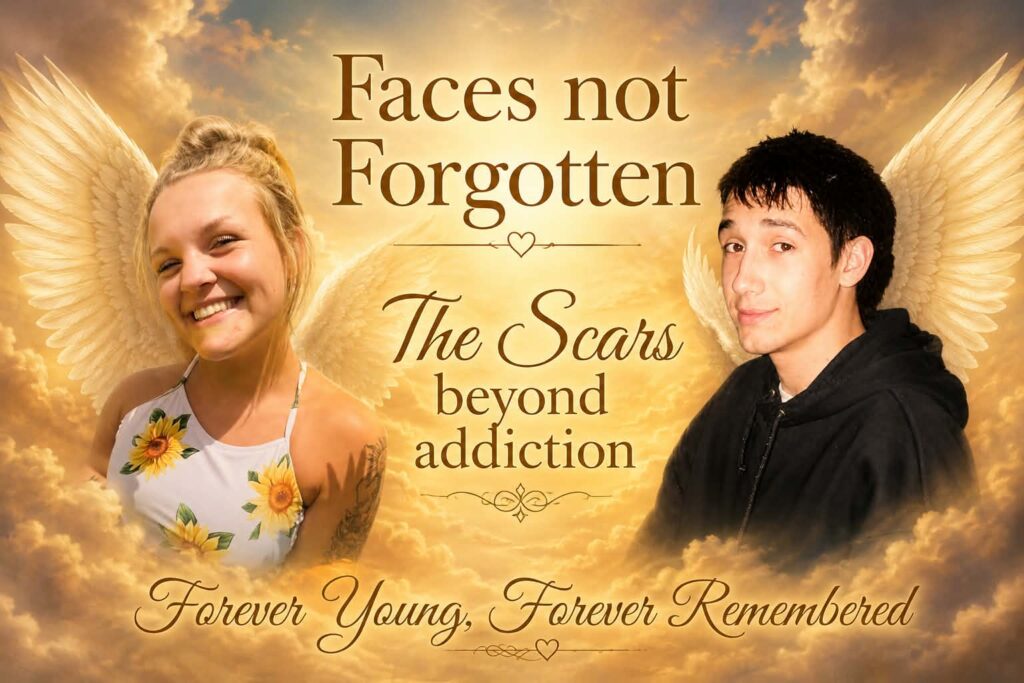
Her identity was shaped through loss, survival, and responsibility. Thomas has carried the weight of addiction’s impact across generations and relationships, including the devastating loss of an older brother, Andrew, forever young at 18, and a sister‑in‑law, Kallie, taken far too early at 21. Thomas has also lost friends who have lost their addiction battles. Those never fully fade; they remain as reminders of how real and indiscriminate addiction is and how quickly it can take someone you love.
But she has also witnessed the other side—her husband and her sister—and the incredible strength of people who dig deep, climb out of dark places, and rebuild their lives. Thomas has seen recovery that sticks, transformation that lasts, and people who never look back. Because of everything she has lived through, this is a woman who values honesty, accountability, loyalty, and genuine relationships. She doesn’t expect perfection—only responsibility, growth, and ownership of one’s choices.
Hope and reality coexist in Thomas’s perspective. “I still have hope because I’ve seen recovery happen, but I also understand the reality of what addiction can take, because I’ve lived it.”
The deeper roots of addiction are clear to her. Thomas has learned that “A large percentage of people struggling with addiction are also battling something deeper. People end up self-medicating instead of getting the help they actually need.” Her empathy comes from seeing the full picture—including the recovery needs that extend far beyond sobriety.
“Recovery doesn’t end when someone leaves treatment. People need safe aftercare housing, transportation, employment, mental health care, and accountability.” Her insight reflects what she’s witnessed in her family and in her community.
One core belief anchors how Thomas supports loved ones: “They need accountability, but they also need compassion. They need to know that recovery is possible and that their life is still worth fighting for.” This belief guides how she supports everyone—with hope, honesty, and love that doesn’t give up.
Each year, the third week of November stands as a reminder that awareness is an act of gratitude—for the stories that survived, the families who keep loving, and the healing that continues in quiet, determined ways. National Addictions Awareness Week calls us to honor not the struggle itself, but the courage, the recovery, and the hope that remain.
Resource:
Home of New Vision, Jackson, Michigan assists people with substance-use disorder in breaking down the barriers to recovery by focusing on the whole-person and providing treatment as well as a full spectrum of support and resources to help navigate the journey to recovery. Ph: 517-788-5596, homeofnewvision.org/
Journalist Tina Cole-Mullins covers a range of topics and issues for Stockbridge Community News, including her Faces of Addiction and mental wellness contributions. A lifelong Dansville resident, she volunteers as a community outreach facilitator, helping ensure individuals and families can access the resources they need.