Reading Between the Lines
’Whose Names Are Unknown’: Vivid stories of the Dust Bowl and beyond may have informed Steinbeck’s novel
by Chuck Wisman
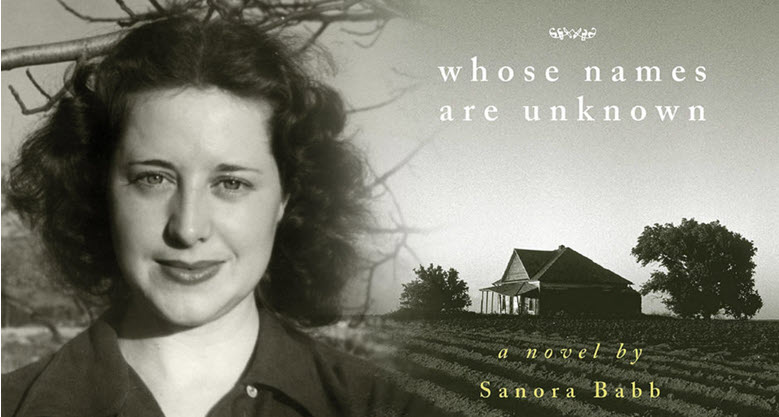
The title of this novel, “Whose Names Are Unknown,” was taken from the multitude of legal eviction notices issued at the height of the 1930s Great Depression and the Dust Bowl. They were issued to those unable to repay their debts due to crop failure, illness, and disability. Because of the overwhelming number of these, the notices were simply issued “To John Doe and Mary Doe Whose True Names Are Unknown.”
Sanora Babb’s novel follows the Dunne family, consisting of “old man Dunne”; his son, Milton; his pregnant daughter-in-law, Julia; and their two daughters, Lonnie (age 5) and Myra (age 7). This well-written book follows the daily trials and travails of the Dunnes and their neighbors as they struggle to survive “dry land” farming in the Oklahoma panhandle in the late 1930s.
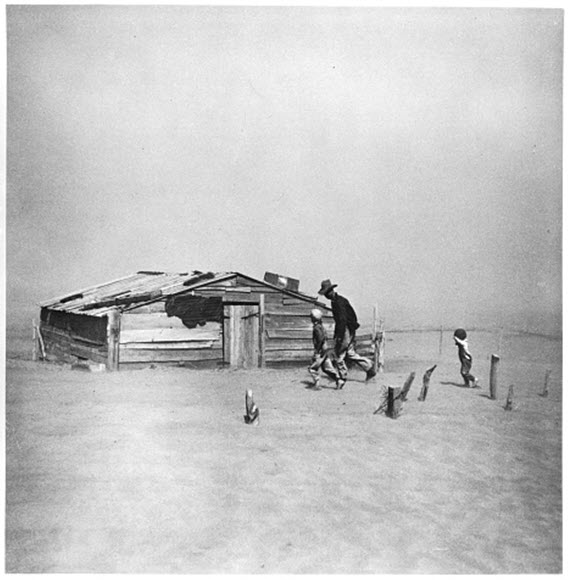
The family lives hand-to-mouth, watching daily for rain and the ever-present threat of dust storms that can block out the sun and bury their meager crops. Like a number of others in the area, they reside in a one-room “dugout”—basically a large hole dug in the ground with a roof, door, and for some, a window. The daughters’ dolls are made from clothespins.
The stories within the novel are engrossing and make the book a difficult one to put down. They involve a number of families and individuals, each with their own personal stories of struggle and survival. For example, Mrs. Starwood is one of the main characters in the novel whose husband recently died in a dust storm. Upon receiving a repossession notice for her property, Mrs. Starwood visits the local bank and a verbal confrontation with the bank manager ensues. She proceeds to dump a freshly killed skunk on the manager’s desk, and the following exchange occurs:
“You’ve disturbed the peace!” he shouted, forgetting himself again. ”And God . . . damn . . . oh, blast it all, you’ve upset the whole bank, business too. Right enough, you’ve disturbed the peace!”
”You’ve disturbed my peace for years,” she said, gathering calm as he grew more excited.
”You don’t understand,” he said . . . ”We meant no harm. It’s simply business.”
The storyline is taken, in part, from Babb’s own life growing up poor in the Oklahoma Panhandle where she kept a journal of her experiences. She even lived in a dugout for a time, similar to the Dunnes.
The book is presented in two parts. The first part describes the Dunne’s desperation and frustration in not having enough to eat, living at the mercy of the weather, and always being in debt to the bank and the local store. While they remain a strong family, they are finally faced with no viable future in dryland farming. Thus, Part Two chronicles their exodus to California as migrant laborers picking whatever crops were ripening at the time.
They were enticed to California by an abundance of flyers expounding on the good pay and readily available work in the California valleys picking cotton, apricots, oranges, beans, peas, etc. What they found in reality was back-breaking stoop labor with little pay, poor or nonexistent housing and company stores where the prices were higher than anywhere else. The local populace did not welcome the “Okies” with open arms. Their children were shunned in school, their squatter camps unwelcome, health care unavailable, and voting rights restricted to only those who had resided in the county for six months.
Babb was born in 1907 in an Otoe Indian community in the Oklahoma Territory. For a time, she lived with her grandfather in his dugout home on a failing broom corn farm. She lived in places where crops routinely failed. Firewood, schools and trees were not seen for a hundred miles. In 1938 she volunteered for the Farm Security Administration in California’s San Joaquin and Imperial valleys, helping organize camps for dispossessed farmers.
Babb kept a diary and began a manuscript of this novel, her first. Her initial assignment was working with Tom Collins, the founding manager of the Weedpatch Camp, a migrant labor camp formally known as the Arvin Federal Government Camp. She kept notes for Collins, and he was so impressed with her work, he asked for a copy for another writer, John Steinbeck.
In 1939, Babb sent four chapters of her manuscript directly to Random House. Bennet Cerf, the founder of Random House, was so impressed he had her complete the manuscript, which became “Whose Names Are Unknown.” Coincidentally, John Steinbeck’s “The Grapes of Wrath” was published at the same time, and Mr. Cerf decided two books on the same subject were not financially viable. Babb’s manuscript was not published and remained in a drawer, not to be seen again until some 60 years later in 2004.
Notably, much discussion circulates among the literati regarding Steinbeck’s appropriation of Babb’s notes that he used in his book and how Cerf didn’t support Babb’s original work, even with a signed contract.
If you’ve read “The Grapes of Wrath,” it’s interesting to then compare it to “Whose Names Are Unknown.”
“Whose Names Are Unknown” is a very fast read, at approximately 200 pages, providing an engrossing and vivid story of family, friends, hardship, and survival. It’s available on order from the Stockbridge District Library.