Reading Between the Lines
‘When I Fell From the Sky’ is a real-life story of survival and fortitude in the Amazon jungle
by Chuck Wisman
On December 24, 1971, Lansa Flight 508 left the Lima, Peru airport headed to Pucallpa, Peru carrying 86 passengers and a flight crew. Among the passengers were 17-year-old Juliane Koepcke and her mother, both German citizens.
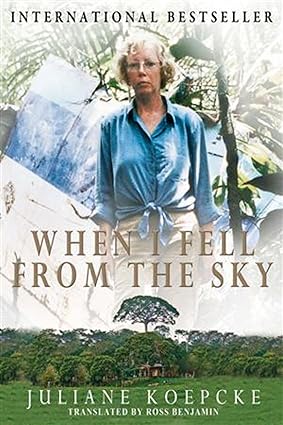
At approximately 10,000 feet during the one-hour flight, the plane disintegrated in a mid-air explosion. Yet, Juliane miraculously survived a fall of two miles into the Amazon jungle still strapped to her seat. Not only did she survive such a fall, but Juliane also managed to persevere in a South American jungle. Much later, she wrote “When I Fell from the Sky,” describing her experience.
Making her way in the jungle—alone—with just her wits, torn clothes, one sandal, and without her eyeglasses, Juliane endured a concussion, several deep cuts to her skin and a broken collarbone for 11 days until finding a miner’s hut for shelter.
The following is just a short excerpt from her experience:
“From one moment to the next, people’s screams go silent. It’s as if the roar of the turbines has been erased. My mother is no longer at my side and I’m no longer in the airplane. I’m still strapped into my seat, but I’m alone. At an altitude of ten thousand feet, I’m alone. And I’m falling, slicing through the sky…at 2 miles above the earth.”
The story actually begins many years before, when her parents, Maria and Hans Koepcke, emigrated from Germany to Peru in the late 1940s. Her parents were well known zoologists intent upon studying life within the Peruvian (Amazon) rainforest. Juliane was born in Peru; she was raised primarily in Lima and later in the rainforest near Pucallpa. Ultimately, her parents established an important and renowned research station and wildlife preserve at Panguana, which exists to this day.
Initially, the family’s living conditions were quite primitive in the rainforest, but this allowed Juliane to experience the jungle in all its complexity and mystery. She learned the joys, intricacies, and dangers of the jungle while becoming more comfortable in its environs. Notably, Juliane never entered the jungle without a pair of boots and a machete.
After the crash, during her 11-day trek through the rainforest, Juliane used every skill at her disposal as well as her knowledge of the rainforest. She rarely saw the sun because the jungle canopy was simply too dense, so Juliane primarily followed streams and rivers hoping they would lead to a large body of water where humans would settle. Often, she had to swim in the middle of a river (with a broken collarbone!) when the jungle became too dense to traverse. This was in spite of river caimans (smaller versions of alligators), poisonous water snakes, bird-eating spiders, and piranha. The water was safe to drink as long as no humans were in the area to foul it. Although her parents had taught her how to light a fire by simply using items from the jungle, it was the rainy season, which made that effort useless.
“When I Fell from the Sky” is an engaging, well-written story of survival, authored by Juliane when she was 56 years of age and translated by Ross Benjamin. The book covers much of Juliane’s early life and that of her parents’ exploration of the rain forest in Peru. She digresses, in various chapters, from her early life and surviving the crash to her parents’ experiences in establishing the research station and, also, how she came to terms with the loss of her mother. Those detours can be a bit disconcerting for readers, but the overall story is well worth the effort. It’s a remarkable chronicle of how a 17-year-old young woman survived a horrific crash, yet had the maturity, skills and intestinal fortitude to survive alone in the jungle for 11 days.
The book also contains numerous photographs that help bring this rather incredible story to life.
Note: In January 2026, science.org reported that the Panguana research station, established by Juliane’s parents and the oldest research station and jungle reserve in Peru, recently suspended its work due to growing conflicts with illegal gold mining operations.
Chuck Wisman still resides locally on the family farm and is retired from state government after almost 40 years of service.