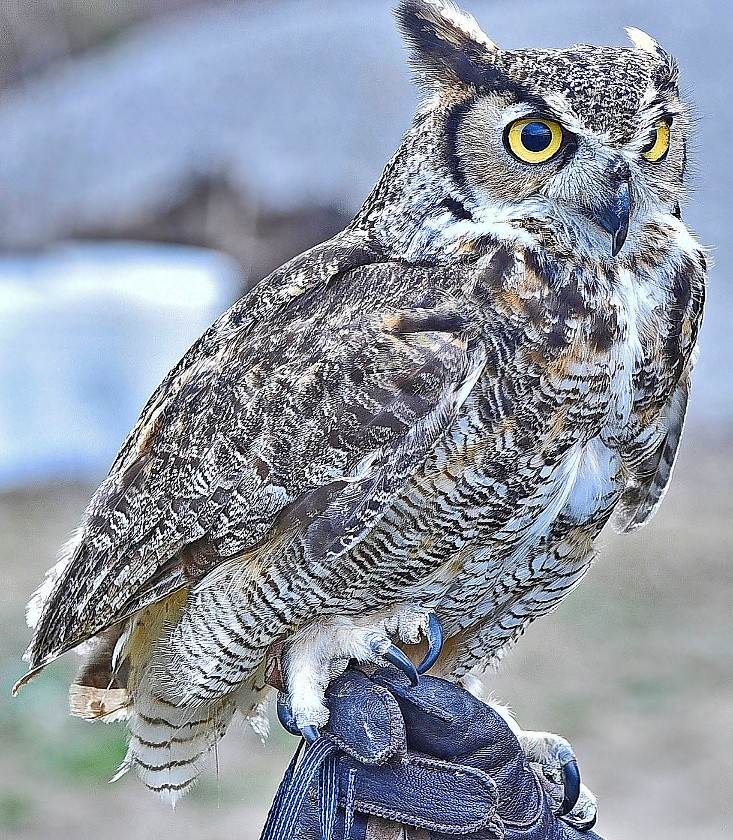
Rural Perspectives: Great horned owls begin nesting here in early February
by Diane Constable
The great horned owl is found throughout North America and is the largest owl in our area.
Its scientific name, Bubo virginianusis, means “large owl first found in Virginia.” Like most owls, they are nocturnal birds, and are rarely seen. But during February evenings and nights, you can sometimes hear great horned owls hooting to each other as they prepare to nest.
As with most raptors, the female is a bit larger than the male, and the male has a deeper “hoot-hoot” call than the female. They can be 18 to 25 inches long, weigh 2 to 3.5 pounds, with a 40-to-57-inch wingspan. Great horned owls are a mottled gray-brown with a red-brown face. The “horns” are tufts of feathering used to communicate with other owls. Their hearing is exceptional and they can hear sounds nearly a mile away. They can fly up to 40 mph, and their feathered talons have a holding force of about 25 pounds—about the same as an eagle. Great horned owls can live up to 30 years in the wild.
Great horned owls begin nesting in our area in early February, often finding abandoned nests in snags and openings in trees, abandoned eagle and squirrel nests, or human-made nest boxes. Nests are mostly made of sticks. The female lays one to four dull white eggs and will incubate them for about 35 days. The chicks will not leave the nest for about six weeks. Fledglings often will be found on the ground or in nearby branches while learning to fly, which takes about another three weeks. As with all fledglings, they are perfectly safe and in no need of rescue.
The great horned owl eats a wide variety of food, including small-to-medium-sized mammals, birds of all sizes, reptiles, insects, fish, and occasionally, carrion. Some of their favorites are rabbits, mice, voles, chipmunks, ducks, crows and starlings. They hunt from a perch, then swoop down to catch the prey. They usually eat the meal whole, as their digestive system is designed to gather up the fur, feathers and bones into a pellet, which is regurgitated.
Fun Facts: This owl flies silently because of the wing shape and fringed feather edges. They have excellent eyesight. Although their eyes cannot rotate, they can rotate their heads 270 degrees to see what is around them.
center in Brooklyn, Michigan. Photo credit Diane Constable

As an avid photographer, Diane Constable regularly puts her formal education in both nature and photography to good use. Diane also enjoys gardening and her dogs. She serves on the board of the Ann Arbor Dog Training Club and is editor of the club’s newsletter.