
The brilliant young engineer behind Dexter’s famous stone viaduct
by Doug Marrin
Reprinted with permission from The Sun Times News, February 2, 2026. Note: This article was originally published on August 10, 2022.
Author’s note: February is Black History Month, a time to honor the achievements, resilience, and lasting contributions of Black Americans whose stories continue to shape our shared history and future.
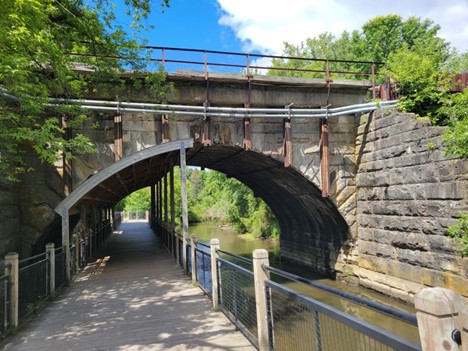
The railroad bridge over Dexter-Pinckney Road leading out of Dexter is a civil engineering marvel designed by a brilliant 25-year-old UM graduate, Frederick B. Pelham.
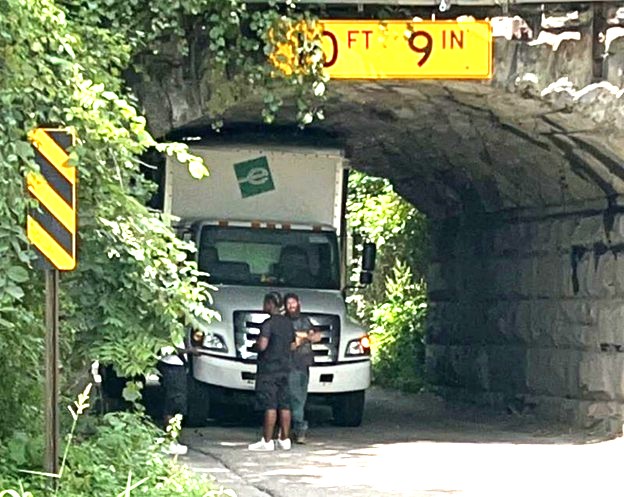
Dexter’s stone viaduct is known for more than one reason. Trucks often get stuck beneath the archway made for horses and buggies. However, Dexter’s infamous truck trap might not be catching vehicles today if it weren’t for Charles Warner’s cow that gave birth on Sunday morning, March 20, 1887.
When Charles Warner didn’t go to church that morning, his parents grew worried. The Dexter Leader reported what happened next in its March 3, 1887, edition:
“A sad and fatal accident which has cast a pall of gloom over the entire community, occurred in our village between the hours of three and four o’clock last Sunday afternoon. Mr. and Mrs. Dennis Warner had started to call on their son Charles whose residence is a short distance across the rail road [sic] track west of the village; as they reached the crossing the Limited Express, (west), running at 45 miles an hour, came suddenly around the curve and signalled for the crossing. Mr. and Mrs. Warner were then crossing. Mr. Warner being slightly in the advance, passed over in safety, but Mrs. Warner evidently became slightly confused, hesitated an instant, and just as she stepped from the track was struck by the pilot of the locomotive, throwing her head against the cylinder, crushing her skull and killing her instantly.”
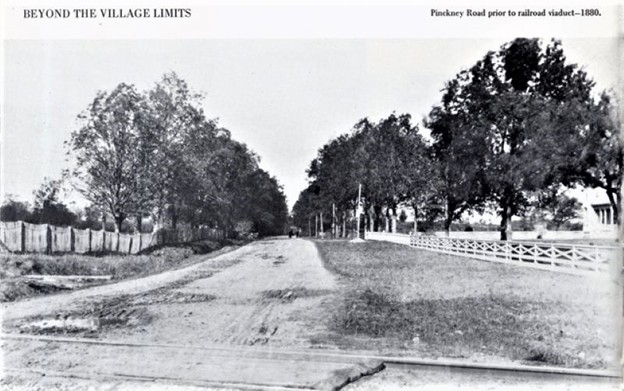
The “pilot” of the locomotive refers to the cowcatcher, not the engineer. The day after the accident, an inquest determined the railroad was not at fault. The Dexter Leader reported on March 28 that the community was so grieved by the tragedy the businesses closed on the day of the funeral. After the funeral, Dexter residents began petitioning the railroad to build a bridge at the crossing.
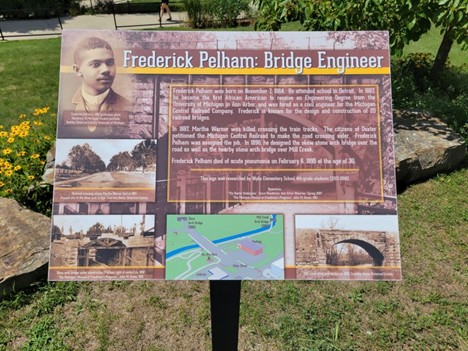
The Michigan Central Railroad assigned its young African American civil engineer Frederick Pelham to design two new bridges for the location—one over the road and the other a few hundred yards further over Mill Creek.
Pelham was born in Detroit at the end of the Civil War in 1864. He graduated from Detroit High School with the highest honors. His father, Robert, was a stonemason, and Frederick frequently worked with him. Frederick excelled in math and attended the University of Michigan, where he received an engineering degree. Frederick was president of his graduating class and graduated at the top of his class in 1887, three months after Mrs. Warner was killed. He was immediately hired by the Michigan Central Railroad and began a career in bridge design and construction. The Michigan Manual of Freedmen’s Progress (John M. Green, 1915) says of Pelham, “The railroad company gave him a position as assistant civil engineer, which he held up to the time of his death. During his service with the Michigan Central Company, he built some 20 bridges along the road. One bridge at Dexter Michigan, is a skew arch bridge. There is only one like it in the country.”
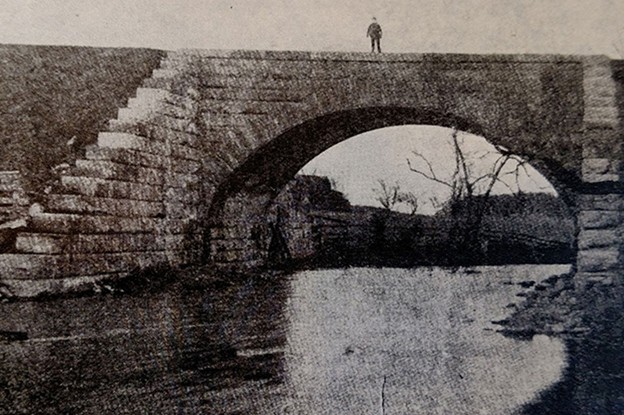
A skew arch design is used when a bridge is not perpendicular to the crossing, and the stone angles must be cut accordingly.
The assignment to build the bridge was a remarkable accomplishment for any 25-year-old, even more so for a young African-American man in the 1800s. But looking at the family from which Pelham came gives insight into the young man’s drive and accomplishment.
Pelham’s parents, Robert and Frances, were free persons and landowners in Virginia. In the 1850s, however, they left the state “where they still were subject to widespread discrimination and onerous legal restrictions, including a prohibition against obtaining an education.” Robert Pelham Sr. firmly believed in the value of a good education and moved his family north to get them one.
Five of the seven Pelham children graduated high school “at a time when few Americans of any race did so.” Robert Pelham Jr. became a journalist, civil servant, and businessman in Detroit and later in Washington D.C. He and his brother Benjamin co-founded and edited the Detroit Plaindealer in 1883. Joseph became a school principal. Meta became a teacher and worked for the Plaindealer. Emma married William Webb Ferguson, the first African-American man elected to the Michigan House of Representatives. He represented Wayne County. Delia married African-American aristocrat George A. Barrier. Frederick, the youngest, followed the high standards set by his older siblings and became a distinguished civil engineer for the railroad.
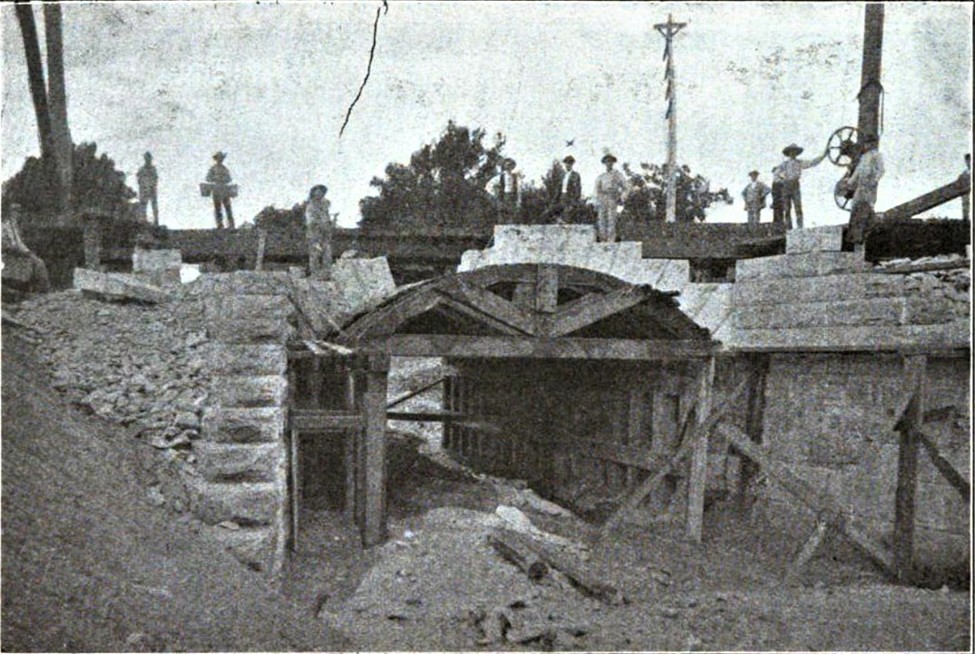
Work began on Pelham’s bridges in Dexter. The earth was moved out from under the railroad track. A temporary wooden support system was installed for the large rocks taken from Mill Creek. The large stones were moved by hand and hewn on-site to the exact size and shape to fit the unique masonry of Pelham’s skew arch bridge.
The Dexter Leader gave readers an update on January 17, 1890, “The work at the Mill Creek railroad bridge is completed for the winter. The abutments are all in and nothing more will be done until the bridge is raised in the spring.”
And on June 6, 1890, “The temporary railroad bridge across Mill Creek was put in last Sunday.”
After that, the Leader reported no more construction updates. The exact date when the new bridge officially opened is unknown. But there was a plaque placed on the bridge commemorating the achievement. Frederick Pelham’s name was not included on the plaque. It is speculated this was because the custom was to list only local dignitaries, or it could have been because of his race.
We don’t hear any more about the bridge. It was doing its job of keeping travelers safe from passing trains. But its sister bridge a few hundred yards away spanning Mill Creek briefly made the news on February 13, 1891, when the Leader reported, “Henry Pryer fell from the rallroad [sic] bridge onto the ice below last Saturday, a distance of nearly twelve faet [sic]. No bones were broken and he is on the gain at present writing.”
Times change, and we often cannot predict the direction the decades will take us. When he built his unique bridge in Dexter, little did Pelham know that one day, residents would find great amusement in seeing modern drays getting stuck underneath. They would view color photos of it on a small screen in their hands just moments after it happened, wherever they are, because of something called the internet, on something called Facebook.
Funny for us, not so much for the truck drivers or those having to reroute unexpectedly. But it’s been happening ever since there were trucks big enough to get stuck. It seems like word would spread. One can’t help but wonder what Pelham would think if he saw his bridge repeatedly rammed by vehicles he could never have imagined, and yet it still stands.
One thing leads to the next, as things always do. Charles Warner’s cow gave birth that Sunday morning in 1887, and here we are with two stone structures still in use today, as elegant as they are durable.
These are remarkable accomplishments for such a young man at the start of his career. And who knows what he could have achieved if his life hadn’t been cut short? Frederick Pelham died at his parents’ home in Detroit in 1895 of acute pneumonia at 30.
Sources:
Dexter Leader (Dexter District Library)
The Dexter Underpass (Grace Shackman, Community Observer, Spring 2007) https://aadl.org/aaobserver/18619
Fred B. Pelham: building bridges (Michigan Engineering, February 28, 2018) https://news.engin.umich.edu/2018/02/fred-pelham-building-bridges/
The Michigan Manual of Freedmen’s Progress (John M. Green, 1915) https://books.google.com/books?id=tjoXAQAAMAAJ&q=pelham#v=snippet&q=pelham&f=false
Robert Pelham Jr. (Wikipedia) https://en.wikipedia.org/wiki/Robert_Pelham_Jr.#cite_note-4
Reprinted by permission in the Stockbridge Community News, March 2026 edition. Original story can be found at thesuntimesnews.com/the-brilliant-young-engineer-behind-dexters-famous-stone-viaduct/