Reading Between the Lines
‘The Salt Path’: What it’s like to lose everything yet claw back your spirit
by Mary Jo David
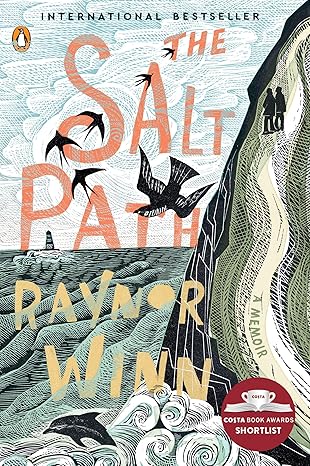
It’s difficult enough reading what prompted the author, Raynor “Ray” Winn, and her husband, Moth, to embark on their 600-plus mile (1,000-plus kilometer) hike in England, but to follow along on their adventure is definitely not a walk in the park.
Although I lean toward a preference for fiction, and tend to avoid books with a lot of description, “The Salt Path” grabbed me from the beginning and held my attention throughout.
Ray and Moth are a couple in their 50s who, after raising two children to adulthood and fighting years of court battles, find themselves with nowhere to live because of a bad investment. Since their farm was also their livelihood, losing their farm also meant losing their only source of income. In a moment of abandon, while hiding away beneath the stairs in their home from bailiffs who have come to change the locks, they make the snap decision to pack up what they can take with them and hit the South West Coast Path in England.
Add to this the news they receive about Moth’s health the week after losing their farm, and you might question the couple’s sanity for setting off on this so-called hiking adventure.
Ray and Moth use their meager savings to purchase camping equipment that is far from top-of-the line, and soon they set out on the path. The South West Coast Path meanders through four counties in England—Somerset, Devon, Cornwall and Dorset. Much of the coastline along the path is rugged and rocky and bordered by large cliffs. Hikers are regularly ascending and descending as they traverse the path. Here and there along the way, the path is peppered with coastal resort towns.
Their finances don’t allow for the expense of B&Bs or even campgrounds, and since “wild hiking” is illegal without landowner permission in England, the Winns must be diligent about selecting unobtrusive sites for setting up camp. Every week, they search out a cash machine to collect their meager dole allotment of 48 pounds (often it was less). Splurging on a chocolate bar or chips from a pub could mean going without food later in the week, yet splurge they did, occasionally. And they learned the hard way how to protect their rare treats from the watchful eyes of coastal seagulls who would swoop down, uninvited, and carry away their few-and-far-between indulgences.
More heartrending than the material sacrifices they made were the occasional reminders that they were homeless and no longer considered productive members of society. This would happen at unexpected times, like when they notice fellow passengers on a ferry who shuffle away from their “aura,” which “smelled faintly like a dead animal.”
Needless to say Ray and Moth have plenty of time for soul searching, and at one point, homeless Ray asks herself, “How can there be so few individuals who understand the need for people to have a space of their own. … As a people, can we only respond to need if we perceive it to be valid?”
The couple regularly faces horrific weather, hunger, and desperate living conditions, but somehow, Ray and Moth persevere thanks to a shared sense of humor. In one moment of levity, after longingly watching as people enjoyed ice cream and sandwiches from a nearby eatery, Ray begins to think through a business plan to turn virtual eating into a weight-loss tool.
Remarkably, their love for each other doesn’t just remain intact, it actually flourishes, as does Moth’s health during parts of the hike.
Yet, “The Salt Path” is not a fairy tale—far from it. The health benefits Moth realizes during the warm weather are quick to dissipate as the cold sets in. Ray is constantly worried about him and whether her hiking brainstorm would ultimately lead to Moth’s death. Yet still they kept walking.
Recently, I’ve begun augmenting some of my reading by looking things up on my cellphone. This was especially true as I enjoyed “The Salt Path.” I regularly turned to my phone to follow the Winns’ progress by using maps of the South West Coast Path I found online. I also searched for images of scenery along the path that helped me to picture some of the breathtaking views the Winns likely took in.
You may be asking yourself, “Wouldn’t it be easier to watch the movie?” Yes, a movie based on “The Salt Path” was released in 2024, and I may yet decide to see it. But by reading the book and using my phone for imagery, I didn’t risk losing out on parts of the couple’s adventure that may have been left on the cutting-room floor.