Reading Between the Lines
‘The Woman Behind the New Deal’: The scope of Frances Perkins’ achievements was breathtaking
by Chuck Wisman
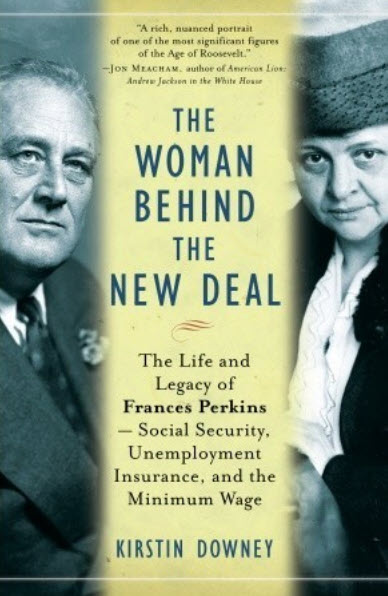
Believe it or not, “The Woman Behind the New Deal: The Life and Legacy of Frances Perkins—Social Security, Unemployment Insurance, and the Minimum Wage” isn’t even close to being the longest book title ever. And while it may not be for everyone (of course what book really is?), if you’re at all interested in the history and origin of our social welfare programs in the U.S., this book is for you.
Many don’t give a second thought to the oft mundane aspects of how we live. Yet, no matter our politics, we as a society continue to receive monthly social security benefits, survivor benefits, unemployment insurance benefits and a minimum wage, without a thought to their origin. That origin is the subject of this extremely well-written biography as personified in Fanny Coralie Perkins (later changed to Frances Perkins), who became the first female to serve in a presidential cabinet in the United States. Perkins was the Secretary of Labor in the Franklin Roosevelt administration and a fascinating personality to boot.
An engaging and easily read book, “The Woman Behind the New Deal,” by Kirsten Downey, was named one of the best biographies of the year in 2009 by the American Library Association and the most definitive biography of Frances Perkins. It moves quickly through the life of Ms. Perkins and her incredible efforts to initiate and move legislation establishing social security, unemployment insurance, the minimum wage, anti-child labor laws, and other initiatives during the days of Roosevelt’s New Deal. The writing animates Perkins’ incredible work to successfully lobby different entities–unions, business owners, Democrats, Republicans, independents, and Franklin Roosevelt—to move the necessary legislation through Congress and get it passed.
Downey explains, “The scope of her list was breathtaking. She was proposing a fundamental and radical restructuring of American society, with enactment of historic social welfare and labor laws. To succeed, she would have to overcome opposition from the courts, business, labor unions, conservatives.”
Perkins grew up in a middle-class family in Worcester, Massachusetts. She was born in 1880 and knew at a young age she wasn’t destined for a traditional role as a wife and mother. According to the biography, she was “an exceptional child, unusually verbal and articulate.”
She graduated from Mt. Holyoke College in 1902 with a degree in chemistry and physics and later obtained a graduate degree in economics and sociology from Columbia University in 1910.
After college graduation, she traveled to New York seeking a job in social work, but was rebuffed due to her young age and lack of experience. Ultimately, she moved to Chicago, teaching science at Ferry Hall, a college for affluent women. There she quickly became a social activist and later returned to New York City to study social work. While in New York, she worked with the destitute, immigrants, and the dispossessed.
On March 25, 1911, Perkins witnessed an event that had a profound impact on her life. She was with friends having tea in New York City when they were interrupted by shouts and the sounds of fire whistles. A large fire had erupted nearby in a ten-story building housing the Triangle Shirtwaist factory that employed hundreds of workers, mostly young, impoverished immigrant women in extremely cramped, and unsafe conditions. With blocked exits and stairwells, many of the employees began jumping from the top floors to their deaths rather than die from the flames and smoke. As Perkins stood there witnessing the mayhem, 146 workers—mostly young Jewish or Italian women—died that day.
Through her social and political contacts, she met and became a close friend and confidant of Franklin Roosevelt when he was serving in New York state government in the very early years of his long political career. Later, as president, Roosevelt invited Perkins to Washington and asked her to become his Secretary of Labor. She only assented if he agreed to support her agenda.
Kirsten Downey well describes Perkins’ incredible ability to curry favor with all kinds of political entities, including influential members of Tammany Hall, unions, businesses, the courts, and politicians of every stripe and party. Besides vividly describing her work to establish needed social welfare programs, Downey delves into the fascinating challenges of Perkins’ personal life in Washington. Her husband had developed a mental illness and she had to depend upon the charity of others to afford living in the Georgetown area of Washington.
This is one book you will likely not regret reading if you’re at all interested in the life of the first and only female in Roosevelt’s cabinet. Perkins was one of the few who lasted the entirety of his administration and, throughout that time, pursued the enactment of historic social welfare and labor laws we all depend upon to this day.
This book provides even greater context by including numerous photographs from that time period, including photos of Frances Perkins.
“The Woman Behind the New Deal” is available on order from the Stockbridge District Library.
Chuck Wisman still resides locally on the family farm and is retired from state government after almost 40 years of service.