Reading Between the Lines
What’s old is Drew again
by Jessica Martell
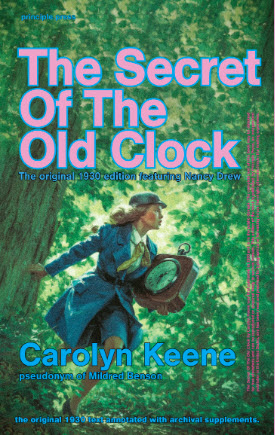
On Jan. 1, 2026, the first four Nancy Drew mysteries entered the public domain when the 95-year copyrights finally expired. Now anyone is legally allowed to reprint and sell these books, originally published in 1930, suddenly making them more widely available than they have been in over 60 years.
In the 1950s, Nancy got a makeover, and modern readers who grew up reading Nancy Drew mysteries may not realize the sleuth they fell in love with is probably Nancy Drew 2.0 rather than the original. Fortunately, readers can now easily get their hands on a copy of Nancy as she was meant to be.
In the 1930s version, the story opens with Nancy sitting in the home library with her father discussing the fate of the estate of the very eccentric and very wealthy Josiah Crowley. The story’s conflict is established on the first page when readers learn that unworthy relatives, the Tophams, are about to inherit Crowley’s fortune.
We get a sense of Nancy’s edge as she describes the Tophams, “Richard Topham is an old skinflint who made his money by gambling on the stock exchange. And Cora, his wife, is nothing but a vapid social climber. The two girls, Isabel and Ada, are even worse.”
Early on, Nancy learns there is a possibility of a second, more recent will, which leaves the Tophams nothing. The story follows Nancy’s dogged pursuit of the second will.
By the 1950s, the powers that be decided Nancy was a bit too much. They aged her up and toned her down. Tragically. She went from a spitfire to June Cleaver. The 1950s version of the story opens with Nancy driving home in her new convertible after running an errand for her father. “It was sweet of dad to give me this car for my birthday…And it’s fun to help him in his work.”
Now who’s the vapid one?
Not only was Nancy herself diminished, so was the writing. The 1930s version is brimming with linguistic delicacies such as, “‘I don’t believe it would do a particle of good,’ Edna interposed.”
By the ‘50s, the vocabulary is simplified and the sentences are short and choppy: “Judy began to cry… Mary smiled… Edna ran into the dining room.”
Whereas the 1930s version is the literary equivalent to curling up in an age-softened antique quilt, the ‘50s version has the staccato tempo of a Dick and Jane book. Similarly, in the older version of the story, the suspense builds slowly as Nancy’s search expands, and the short chapters keep the pace moving along at a good clip. Meanwhile, in the newer version, readers are smacked in the face with instant drama as Nancy watches a 5-year-old girl narrowly miss being plowed down by a getaway van, only to fall off a bridge, hit her head, and land in the shallow water of the riverbank.
1950s Nancy Drew played an important role in American literature, but if you’re ready to level up, 1930s Nancy Drew is an absolute delight. Mystery lovers will enjoy this charming romp through yesteryear, and readers who grew up with the newfangled Nancy owe it to themselves to take the old gal out for a spin.
Jessica Martell spent 17 years as a high school English teacher before accepting her current position as an educational consultant. She and her husband live in Munith with their cat, Scootie.